Ball Club Lake, Minnesota
Ball Club Lake Fishing Guide: A Clear-Water North Woods Fishery
This Ball Club Lake Fishing Guide brings together verified lake facts, fish species, seasonal context, a Minnesota DNR contour map, public access information, and practical trip-planning insight for anglers.
Ball Club Lake sits in Itasca County near the community of Ball Club, within the Chippewa National Forest and the Leech Lake Reservation. It is a substantial lake with 4,335.27 acres of surface water, 19.47 miles of shoreline, and a maximum depth of 85 feet in the current Minnesota DNR LakeFinder record. The setting feels distinctly North Woods, with long stretches of natural shoreline and enough water to offer several different fishing situations in one day.
Depth is only part of the story. The DNR lists 984 acres of littoral area, which is the shallower portion where sunlight can support aquatic vegetation. Those shallow and mid-depth zones meet sharp breaks, broad basins, points, inside turns, and offshore structure. That combination gives northern pike, walleye, panfish, and forage fish room to move as water temperature, light, wind, and food availability change through the season.
Average water clarity is listed at 12.9 feet. Clear water can make depth, boat position, wind direction, and presentation speed especially important. A productive location at dawn can feel empty under a bright midday sky, while a wind-driven edge can become active quickly. The goal is not to fish every contour. It is to identify the structural zone and depth range that match the day.
How to Use This Ball Club Lake Fishing Guide
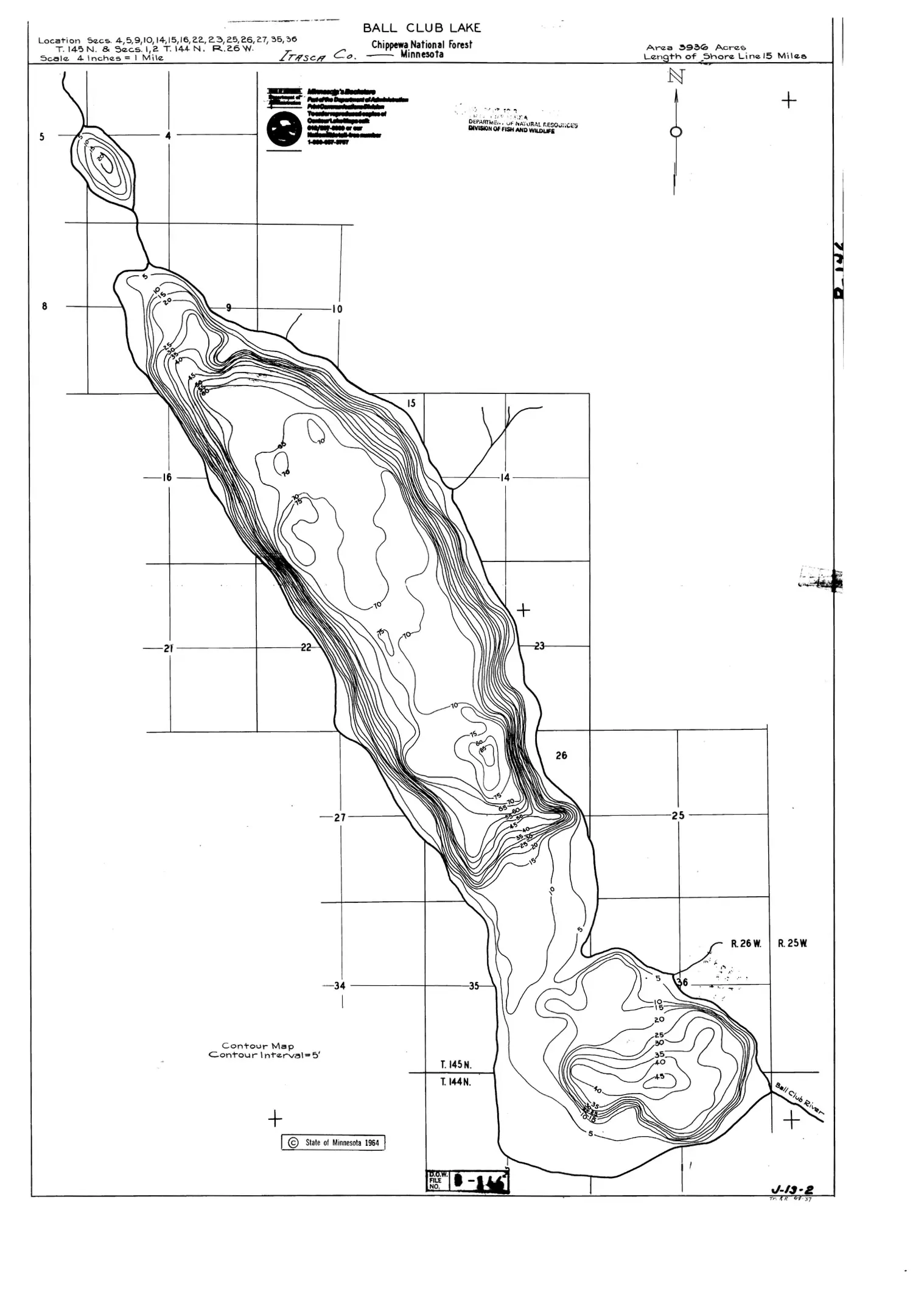
In fact, Ball Club is not a one-pattern lake. Its mix of shallow habitat, deep water, and defined contours rewards anglers who treat the lake as a collection of zones. For example, weed edges and shoreline breaks can concentrate fish during one part of the year, while basin edges and offshore structure become more important as water warms or forage shifts. The contour map below helps show where these zones connect.
Meanwhile, northern pike are a major part of the fishery and show up throughout the lake. They can relate to vegetation, changes in bottom composition, shoreline points, and deeper breaks. Walleye are present too, but the 2022 DNR survey described their gill-net catch rate as lower than comparable lakes and typical for Ball Club. As a result, precise positioning and timing can be more valuable than simply covering water at random.
In addition, tullibee, also called cisco, are an important deep-water forage species. For example, a 2022 special sample found them abundant, and a 2025 survey documented a suitable cold, oxygenated layer that was 23.8 feet thick at the time of sampling. That measurement describes habitat during a survey visit, not a current fishing depth. It does help explain why the lake supports a deeper cold-water component alongside its productive shallows.
For that reason, visiting anglers should begin with a seasonal plan and adjust it to the day in front of them. Wind, cloud cover, water temperature, and recent weather can change which side of a piece of structure is most useful. A guide who knows the lake can shorten that search and help translate the map into productive boat position.
Reading Ball Club Lake Structure
However, the 85-foot maximum depth does not mean most fishing happens in the deepest water. Instead, use the contour map to find connections: a shallow feeding area beside a defined break, a point that extends toward a basin, or a broad shelf that narrows into an inside turn. Those connections give fish efficient routes between cover, forage, and comfortable water. They also give anglers a logical sequence of places to check.
Because Ball Club covers more than 4,300 acres, travel time matters. Group nearby points, weed edges, and basin transitions into a practical route before launching, then adjust that route as wind or weather changes. A short sequence of connected areas usually provides more useful feedback than crossing the lake repeatedly without a clear reason.
Finally, clear-water lakes reward observation. Note the windward side, water color, visible vegetation, surface activity, and the depth where bait appears on electronics. If one element repeats across several locations, it may be more useful than the name of the spot. That process is a major part of guided fishing and helps anglers build a pattern they can understand, not just follow.
Find the lake
Ball Club Lake Location
Ball Club Lake is in Itasca County near the community of Ball Club, Minnesota. The map is centered on the lake using the coordinates in the DNR lake record, so visitors can see the surrounding roads before choosing an access.
Lake center: 47.359313, -93.943037
Map location is for trip planning. Confirm the launch you intend to use before towing to the lake.
The fishery
Ball Club Lake Fishing Guide: Species and Survey Context
The Minnesota DNR lists eleven fish species in Ball Club Lake. However, the four overview cards summarize headline fishing and food-web roles, not a ranking. Instead, use the interactive guide below to explore every listed species in beginner-friendly detail.
Primary target
Northern Pike
Pike are a defining Ball Club species. The 2022 DNR gill-net sample found pike from 14.3 to 32.9 inches, with an average length of 22.1 inches. They can use shallow vegetation, transition edges, points, and deeper structure as conditions change.
Classic North Woods target
Walleye
The 2022 survey sampled walleye from 10 to 26 inches, with a mean length of 17.5 inches. Twenty-three percent were longer than 20 inches. The DNR described abundance as lower than comparable lakes but typical for Ball Club.
Deep-water forage
Tullibee, or Cisco
Cisco connect Ball Club’s cold, deep habitat to its predator fishery. Their presence can influence where larger fish travel, especially around basin edges and temperature transitions. Deep-water habitat should be handled with care during warm conditions.
Shallow-water community
Panfish and Perch
Bluegill and yellow perch were numerically common in 2024 trap-net work. Black crappie, pumpkinseed, and rock bass add variety. Vegetation, woody cover, and protected shoreline areas can all matter to these species.
Interactive species guide
Meet the Fish of Ball Club Lake
Choose a fish to see what it looks like, how a beginner can recognize it, where it fits in the lake, and what recent DNR surveys actually documented.
11DNR-listed species
Northern Pike selected.
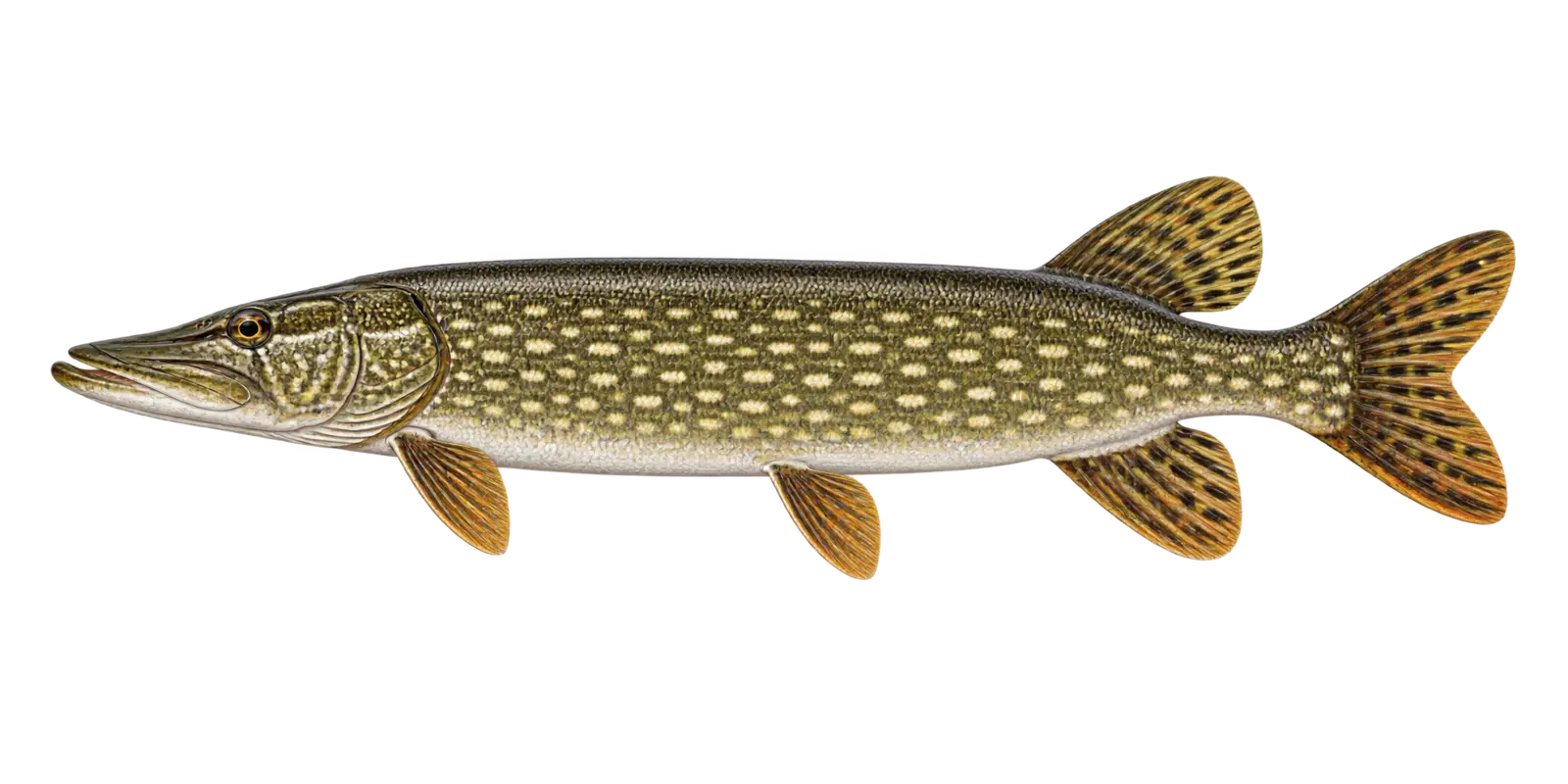 Light spots on a dark body
Primary target
Northern Pike
Esox lucius
- Spring
- Fall
- Winter
A fast ambush predator and one of Ball Club’s defining game fish. For example, pike may use shallow vegetation, breaklines, points, and deeper structure as light, temperature, and forage change.
How to recognize it
In particular, look for a long torpedo body, a broad duckbill snout, pale bean-shaped spots on darker green sides, and a dorsal fin placed far back near the tail.
Ball Club survey snapshot
The 2022 DNR gill-net sample measured pike from 14.3 to 32.9 inches, averaging 22.1 inches. Seven percent were longer than 28 inches.
Where it tends to be
Weed edges and shallow cover are classic starting points, but larger fish can move along breaks and deeper structure when conditions push prey away from shore.
Often confused with
By contrast, muskellunge usually show dark markings on a lighter body. Northern pike show lighter spots on a darker body.
Starting depth zone
Vegetation, breaks, and deeper structureA flexible zone, not an exact fishing location.
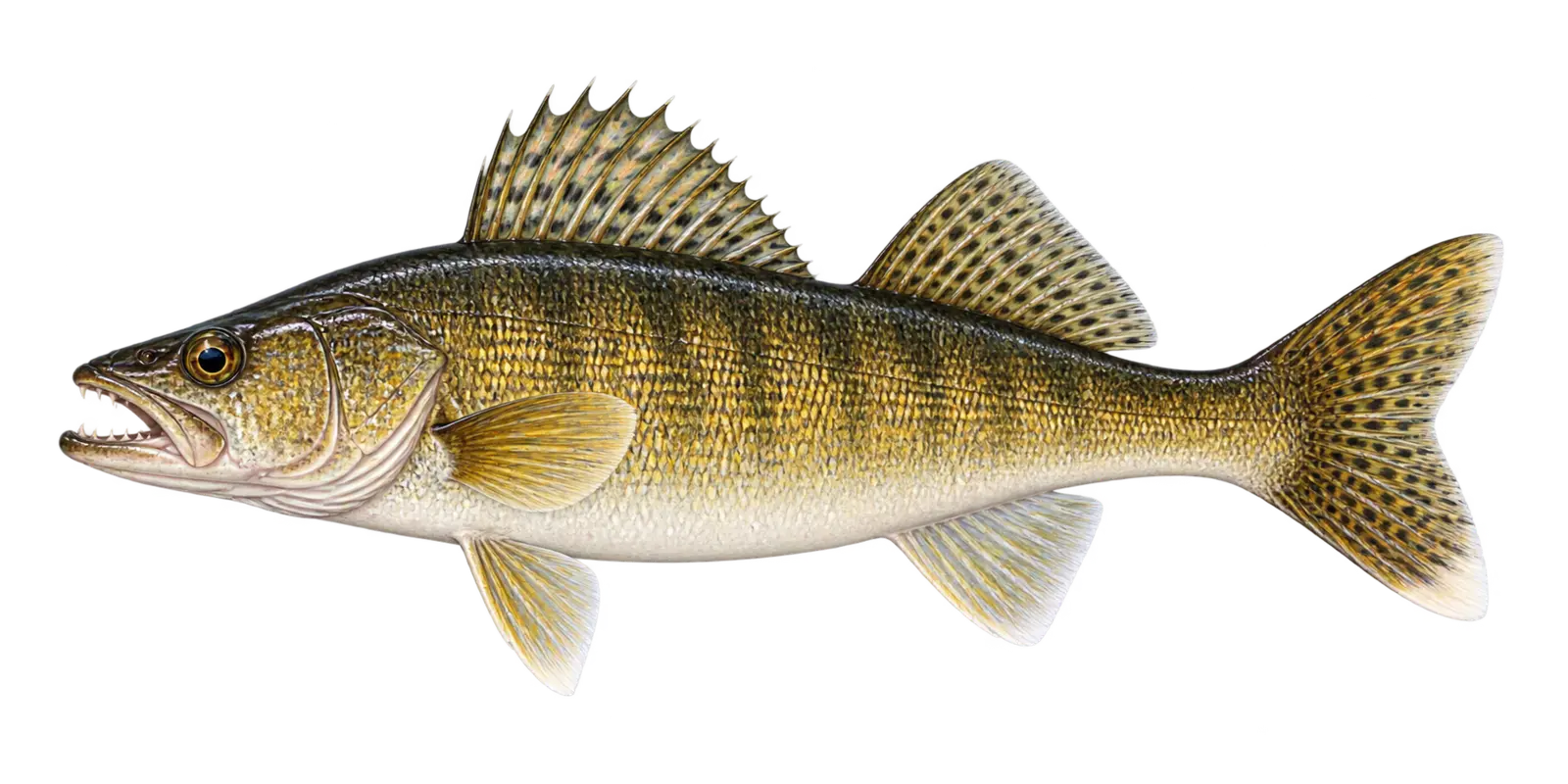 White lower tail tip and reflective eye
Classic target
Walleye
Sander vitreus
- Spring
- Summer
- Fall
- Winter
Walleye are built for low-light feeding. On a clear lake, however, wind, cloud cover, dawn, dusk, and access to deeper water can all affect where they are comfortable.
How to recognize it
For example, a large glassy eye and bright white lower tip of the tail are the easiest field marks. Its mouth has noticeable canine teeth, and the two dorsal fins are separate.
Ball Club survey snapshot
In 2022, the survey measured walleye from 10 to 26 inches, with a mean of 17.5 inches. Twenty-three percent were longer than 20 inches.
Where it tends to be
Shoreline breaks, points, wind-driven edges, and offshore structure are useful starting zones. However, bright conditions can move fish deeper or tighten them to structure.
Often confused with
By contrast, sauger have rows of black spots on the dorsal fin and lack the walleye’s clear white lower tail tip.
Starting depth zone
Low-light shallows through deeper structureDepth changes with light, wind, forage, and season.
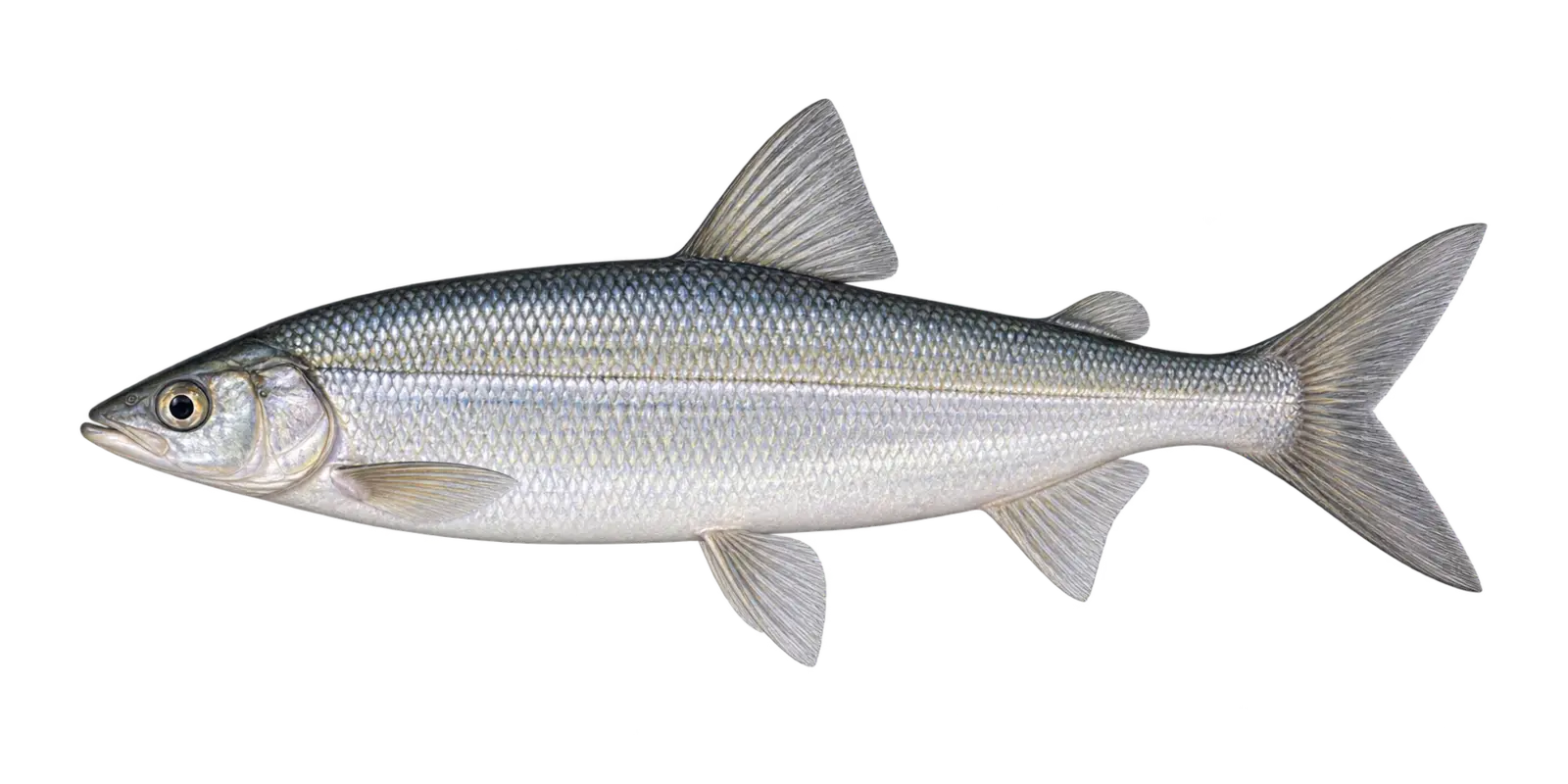 Silver cold-water forage fish
Deep-water forage
Tullibee (Cisco)
Coregonus artedi
- Summer deep water
- Fall spawning
Cisco connect Ball Club’s cold basin habitat to its predator fishery. As a result, their depth can influence where larger fish travel.
How to recognize it
In particular, look for bright silver sides, a deeply forked tail, a small fleshy adipose fin near the tail, and a lower jaw that reaches to or slightly beyond the snout.
Ball Club survey snapshot
A special 2022 deep-water sample collected 57 cisco from 6.5 to 12.6 inches, averaging 8.9 inches. In 2025, the DNR measured a 23.8-foot layer of suitably cold, oxygenated habitat.
Where it tends to be
Cisco need cool, oxygenated water. Consequently, summer habitat often means deeper basin water and temperature transitions rather than warm shoreline areas.
Often confused with
By contrast, lake whitefish have a more overhanging snout and a small mouth set below it. Cisco have a more forward lower jaw.
Starting depth zone
Cold, oxygenated basin waterWarm-water handling at depth deserves extra care.
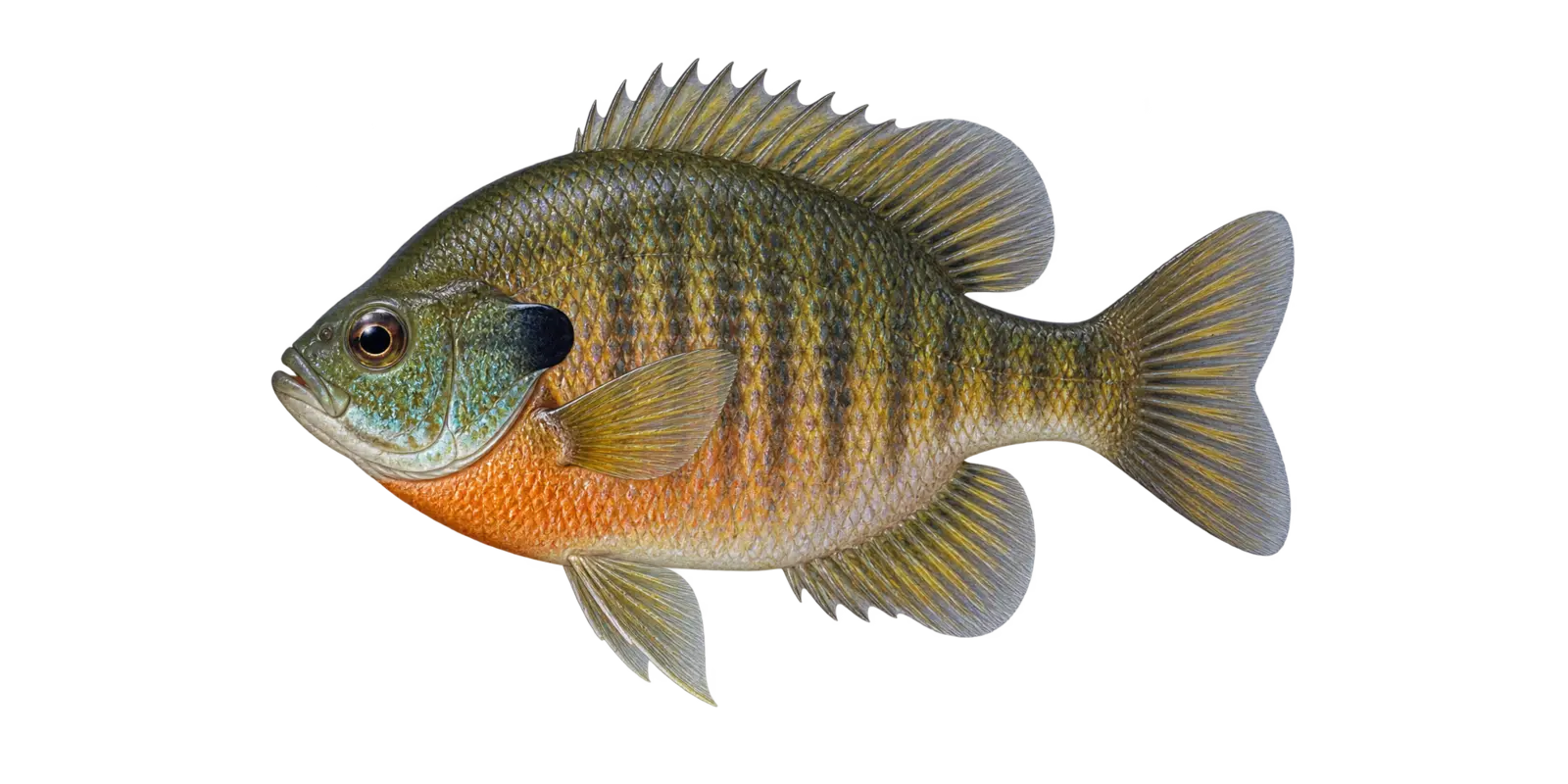 Dark ear flap and small mouth
Panfish
Bluegill
Lepomis macrochirus
- Spring
- Summer
- Winter
Bluegill are one of the easiest fish for a new angler to recognize and pursue. For example, they often relate to vegetation, protected shorelines, docks, and nearby cover.
How to recognize it
In particular, look for a deep round body, a small mouth, blue-green color on the cheek and throat, faint vertical bars, and a solid dark ear flap without a bright red rear crescent.
Ball Club survey snapshot
In 2024 trap nets, bluegill averaged 4.8 inches and ranged from 2.6 to 9.0 inches. Thirty percent were longer than 7 inches and 22 percent were longer than 8 inches.
Where it tends to be
Shallow weeds and protected cover are good starting zones. Meanwhile, fish can also gather along weed edges or suspend nearby as the season progresses.
Often confused with
By contrast, pumpkinseed have bright blue facial lines and a red-orange crescent on the rear edge of the ear flap.
Starting depth zone
Shallow weeds, cover, and nearby edgesSchools can shift deeper during bright or warm periods.
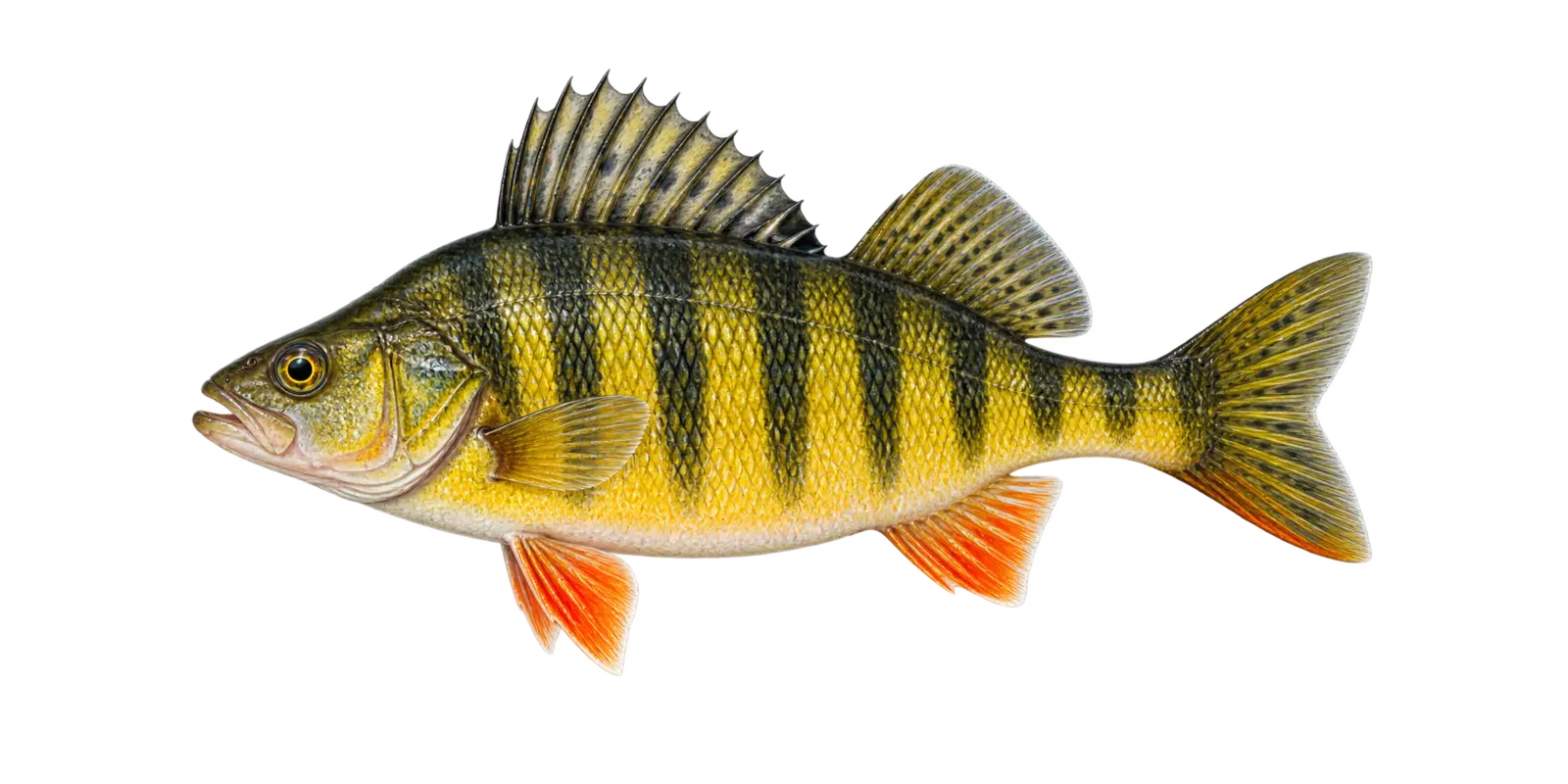 Dark bars and orange lower fins
Panfish and prey
Yellow Perch
Perca flavescens
- Spring
- Fall
- Winter
Yellow perch are both an angling opportunity and an important prey fish. As a result, they may gather in schools over flats, along weed edges, and near basin transitions.
How to recognize it
For example, the golden-yellow body, six to eight dark vertical bars, orange lower fins, and two separate dorsal fins make this one of the easiest species to identify.
Ball Club survey snapshot
Yellow perch made up 31 percent of the 2024 trap-net catch by number. Measured fish averaged 6.0 inches and ranged from 4.1 to 8.9 inches.
Where it tends to be
First, start around shallow flats and vegetation. Next, follow the edges toward deeper water because schools can move widely with forage and season.
Often confused with
By contrast, young walleye are less yellow, show different mottling, and have the walleye’s characteristic white lower tail tip.
Starting depth zone
Flats, weed edges, and basin transitionsPerch can roam from shallow water to deeper schools.
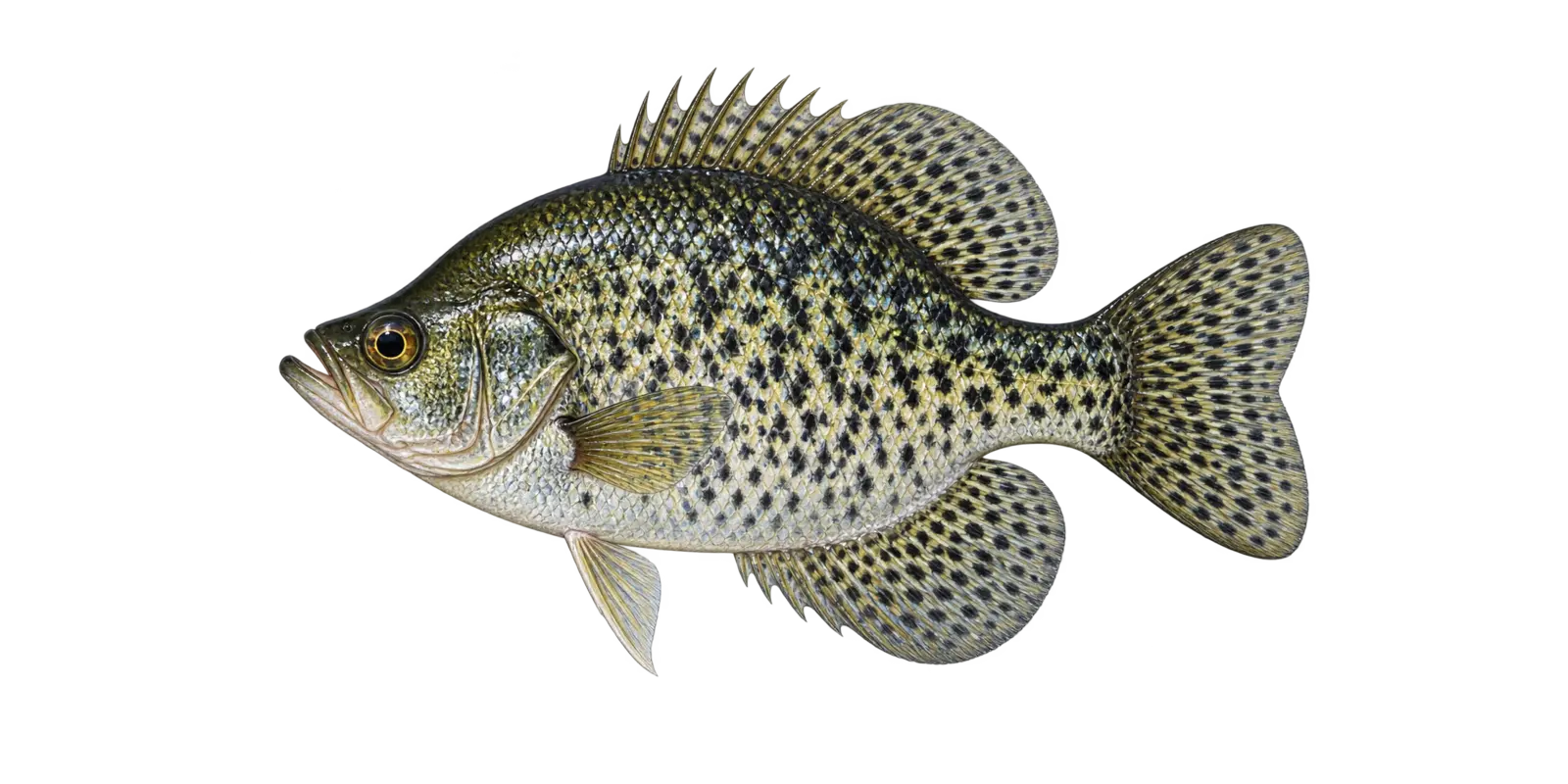 Irregular black mottling
Panfish
Black Crappie
Pomoxis nigromaculatus
- Spring
- Summer
- Winter
Crappie often travel in loose schools and may hold around vegetation, wood, or suspended over deeper water. In general, their position can change quickly with light and forage.
How to recognize it
For example, look for a deep compressed body covered with irregular black blotches, a slightly upturned mouth, and seven or eight spines along the front of the dorsal fin.
Ball Club survey snapshot
However, only two black crappie were measured in 2024 trap nets, at 9 to 12 inches. That is too small a sample to describe the lake’s full crappie population.
Where it tends to be
Protected vegetation and woody cover are good starting points in spring. During other periods, schools may suspend along edges or over deeper water.
Often confused with
By contrast, white crappie usually show more organized vertical bars and have fewer dorsal spines. Black crappie look more randomly mottled.
Starting depth zone
Cover, weed edges, and suspended schoolsCrappie depth can change quickly during the day.
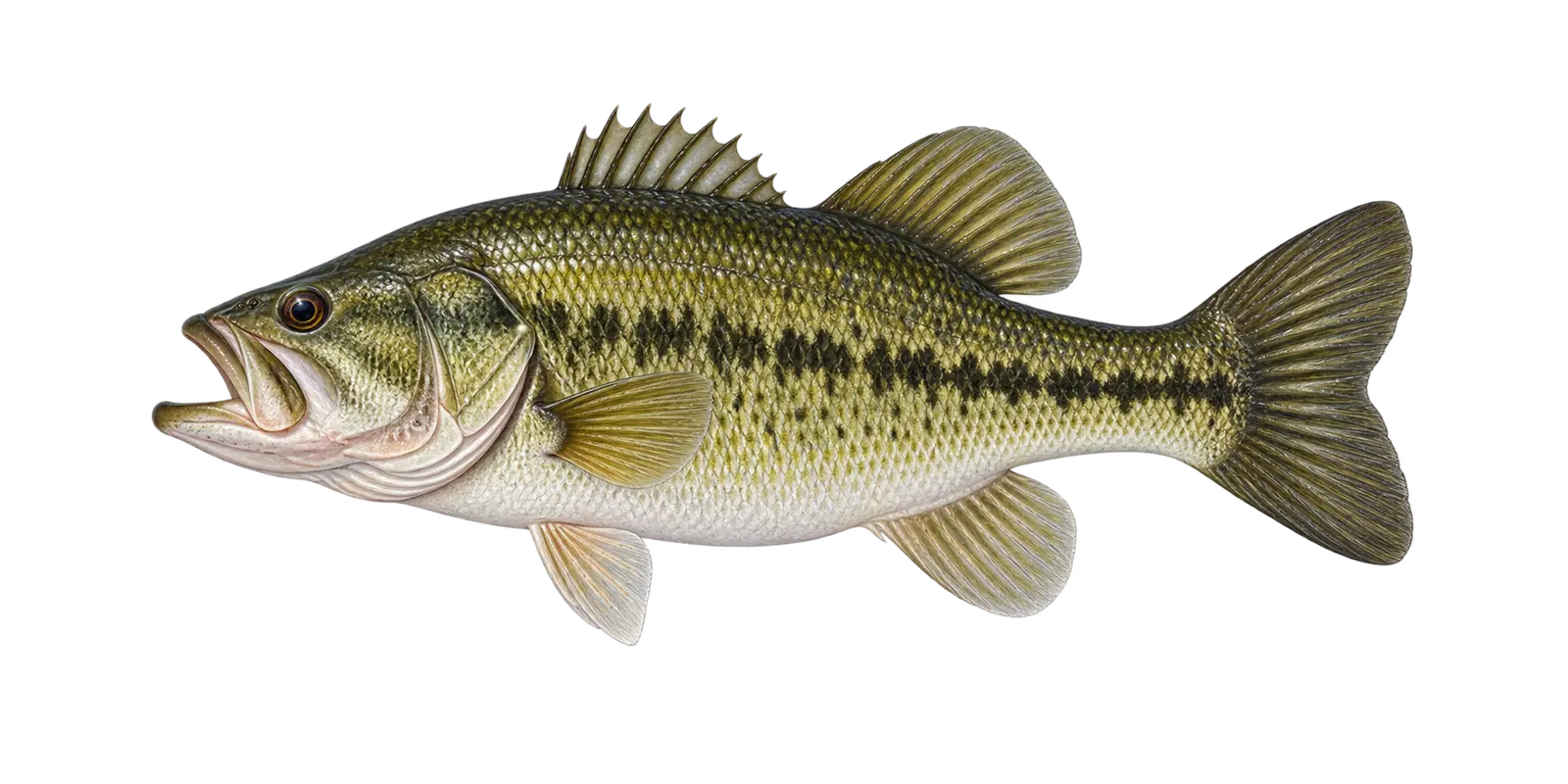 Large jaw and dark side stripe
Game fish
Largemouth Bass
Micropterus salmoides
- Spring
- Summer
- Fall
Largemouth bass are cover-oriented predators. For example, vegetation, wood, protected bays, and a nearby drop are all useful pieces of a bass location.
How to recognize it
In particular, the upper jaw extends behind the eye, and a bold broken dark stripe runs along the side. A deep notch separates the spiny and soft sections of the dorsal fin.
Ball Club survey snapshot
Notably, the 2024 nearshore seine work documented many young largemouth bass using shoreline nursery habitat. Trap nets are not designed to describe the adult bass population.
Where it tends to be
Look around weed beds, inside turns, wood, and protected shorelines. However, nearby deeper water can become more important in clear or bright conditions.
Often confused with
By contrast, smallmouth bass have vertical bars and a smaller jaw that usually ends near the middle of the eye rather than extending behind it.
Starting depth zone
Vegetation, shoreline cover, and nearby dropsCover and access to depth matter more than one number.
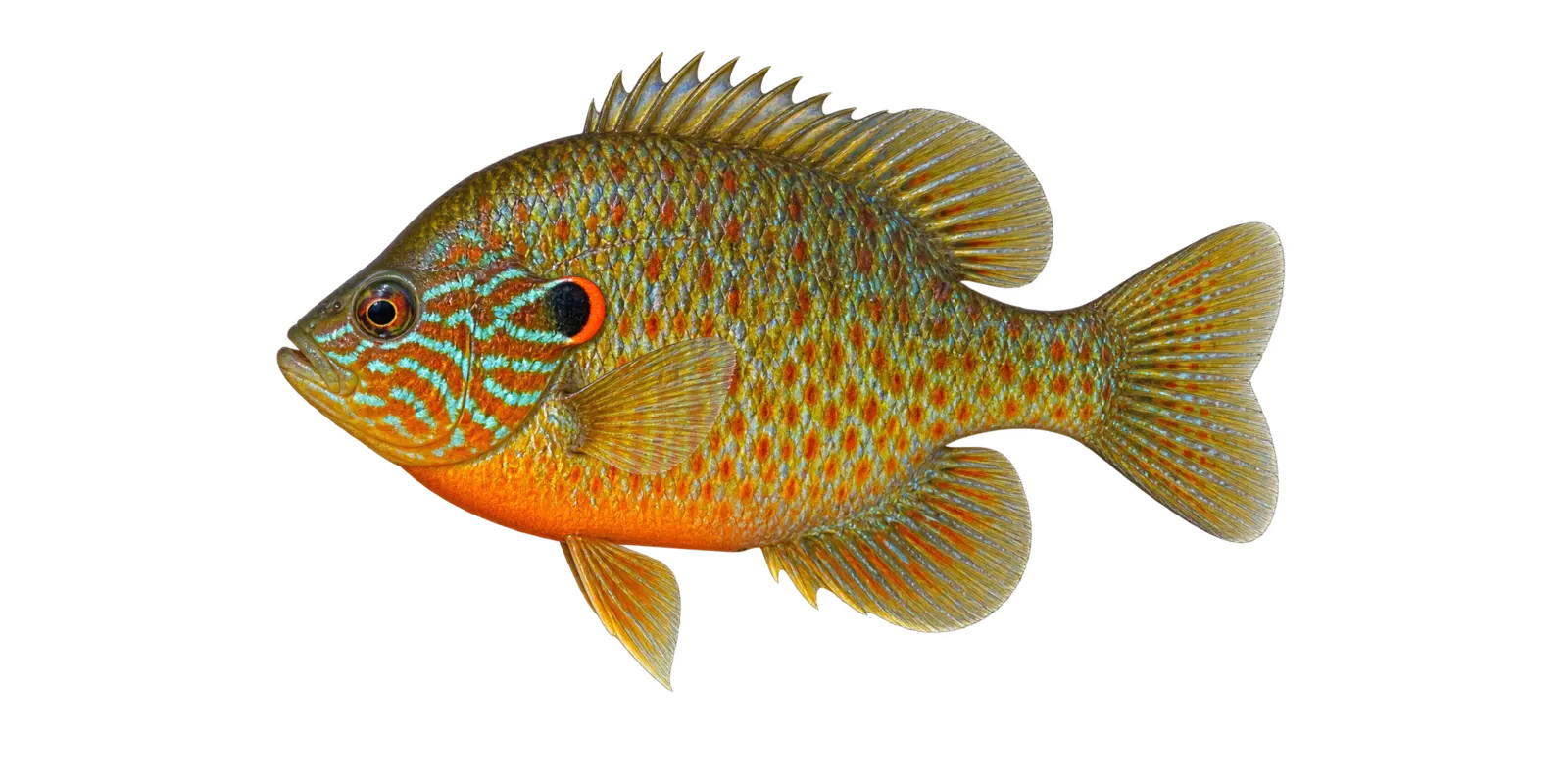 Blue face lines and orange ear crescent
Panfish
Pumpkinseed
Lepomis gibbosus
- Spring
- Summer
Pumpkinseed are colorful shoreline sunfish. For example, they commonly use shallow vegetation and firm-bottom areas where small invertebrates are available.
How to recognize it
In particular, look for bright blue-green wavy lines on the cheek and a black ear flap ending in a red-orange crescent. Its body is deep and round.
Ball Club survey snapshot
In 2024, trap-net measurements included pumpkinseed from 2 to 8 inches. However, that sample documents several sizes without defining the entire population.
Where it tends to be
Shallow weeds, protected shoreline, and firm sand or gravel patches are useful starting habitat, especially during warmer months.
Often confused with
By contrast, bluegill have a plain dark ear flap without the pumpkinseed’s bright red-orange crescent and bold blue facial lines.
Starting depth zone
Very shallow vegetation and firm shorelineA shoreline-oriented sunfish in much of the open-water season.
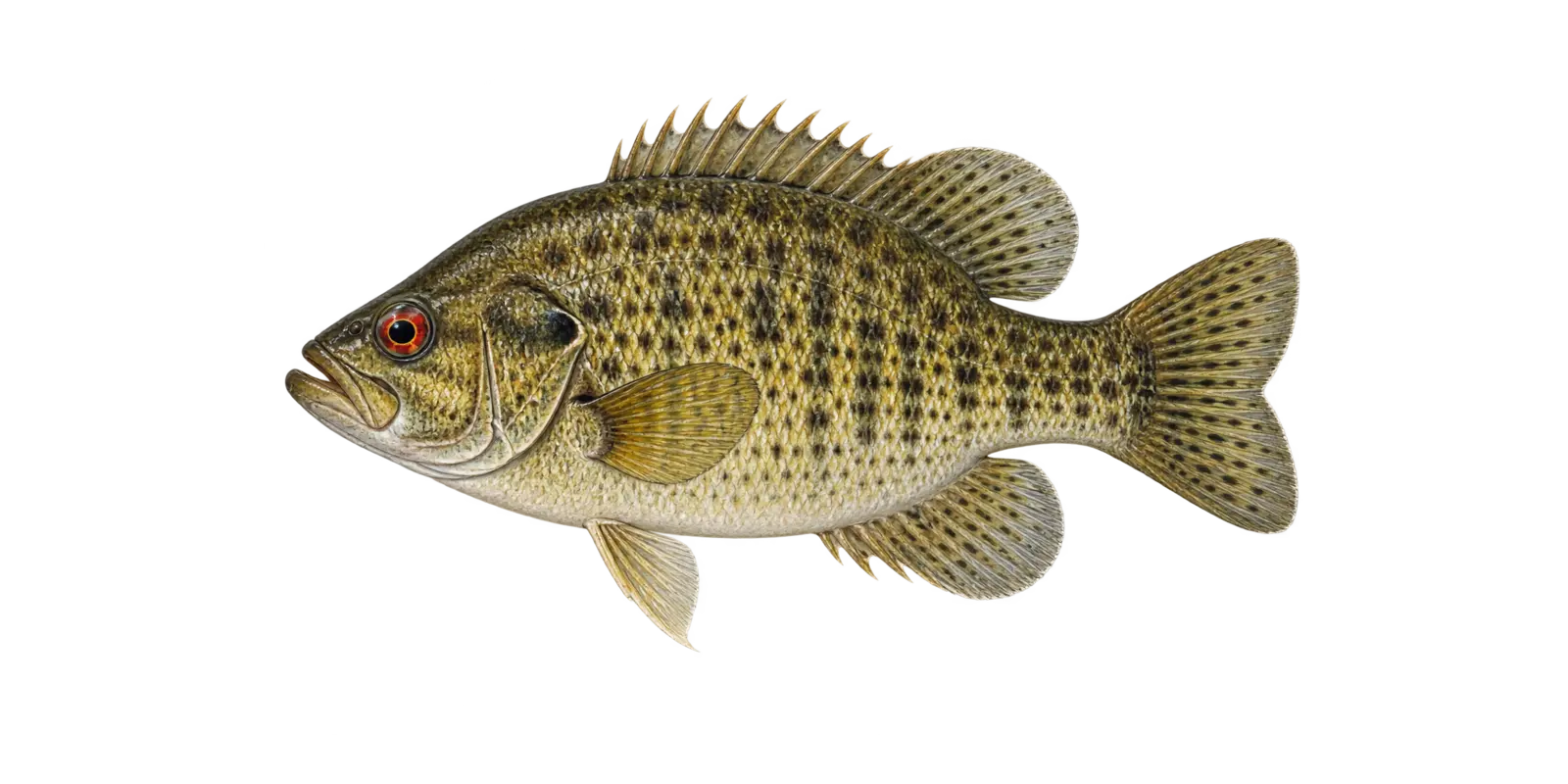 Red eye and mottled body
Panfish
Rock Bass
Ambloplites rupestris
- Spring
- Summer
- Fall
Rock bass are sturdy cover fish with a surprisingly large mouth. For example, rock, wood, shade, and firm shoreline edges are useful places to recognize their role.
How to recognize it
In particular, a deep red-orange eye, olive-bronze mottling, a stout body, and a mouth larger than most sunfish are the quickest clues.
Ball Club survey snapshot
Rock bass appeared in the 2022 standard survey and 2024 nearshore work. However, the fish measured in the 2024 trap-net table were small juveniles, not a complete size picture.
Where it tends to be
Rocky banks, wood, shade, and firm edges can all hold rock bass. Therefore, they often stay close to cover rather than roaming open water.
Often confused with
By contrast, crappie have a thinner, more compressed profile. Smallmouth bass are more elongated and lack the rock bass’s classic red eye and sunfish shape.
Starting depth zone
Rock, wood, and firm edgesCover is usually the more useful clue.
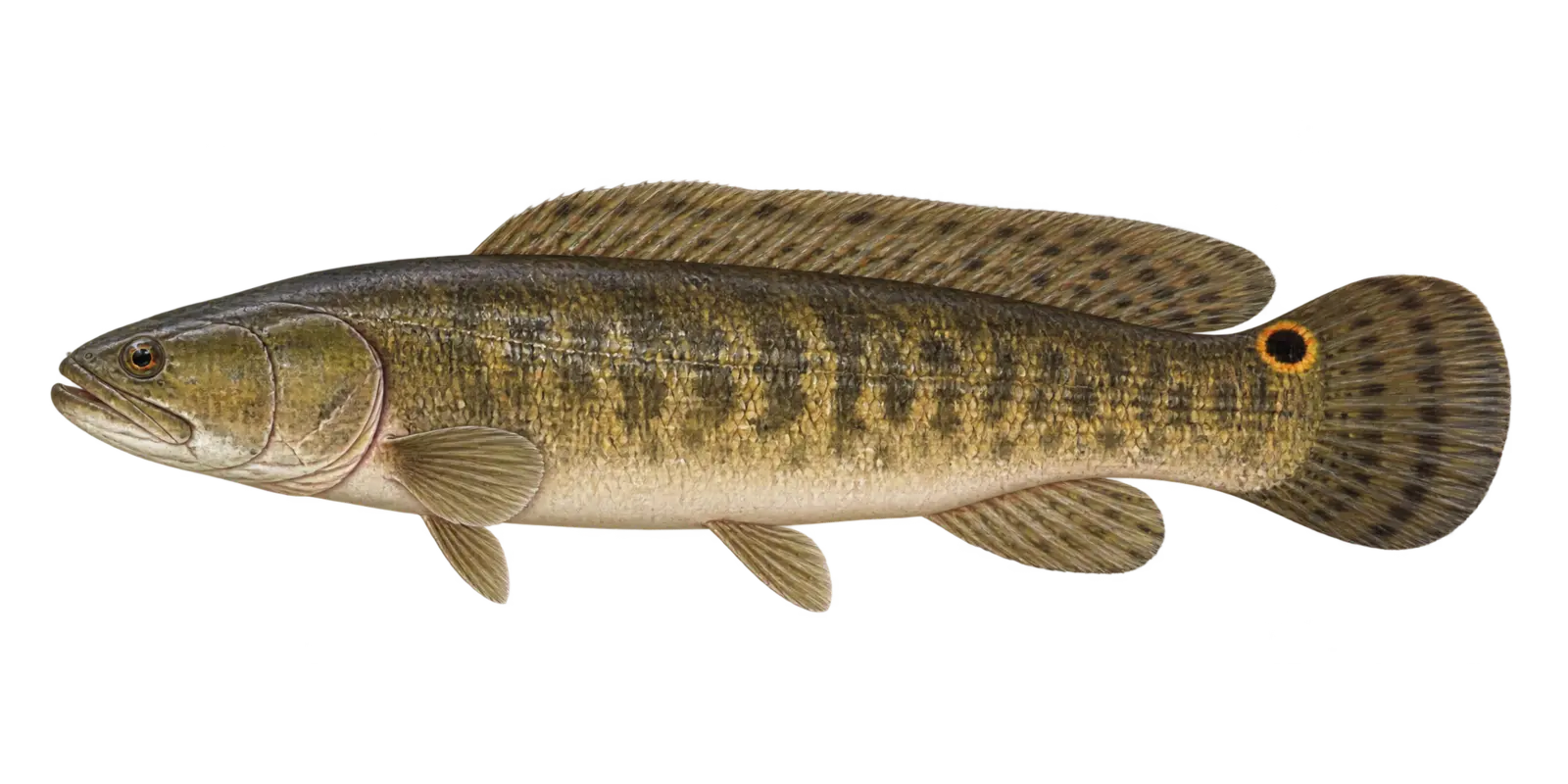 Long dorsal fin and rounded tail
Native predator
Bowfin (Dogfish)
Amia calva
- Spring
- Summer
Bowfin are an ancient native fish, not an invasive species. In fact, they can breathe air at the surface and are well suited to warm, weedy, lower-oxygen habitat.
How to recognize it
In particular, the long low dorsal fin runs across more than half the back, the tail is rounded, and males often show a dark eyespot ringed with orange near the tail.
Ball Club survey snapshot
Seven bowfin measured in 2024 trap nets ranged from 16 to 26 inches. Notably, bowfin made up 46 percent of trap-net biomass, which is not the same as 46 percent of fish by number.
Where it tends to be
Shallow weeds, backwaters, and protected warm-water cover fit this species. As a result, bowfin can tolerate habitat that is uncomfortable for many game fish.
Often confused with
By contrast, burbot have a chin barbel and two dorsal fins. Bowfin have no chin barbel and one very long continuous dorsal fin.
Starting depth zone
Shallow, warm, weedy coverA cover-oriented native predator.
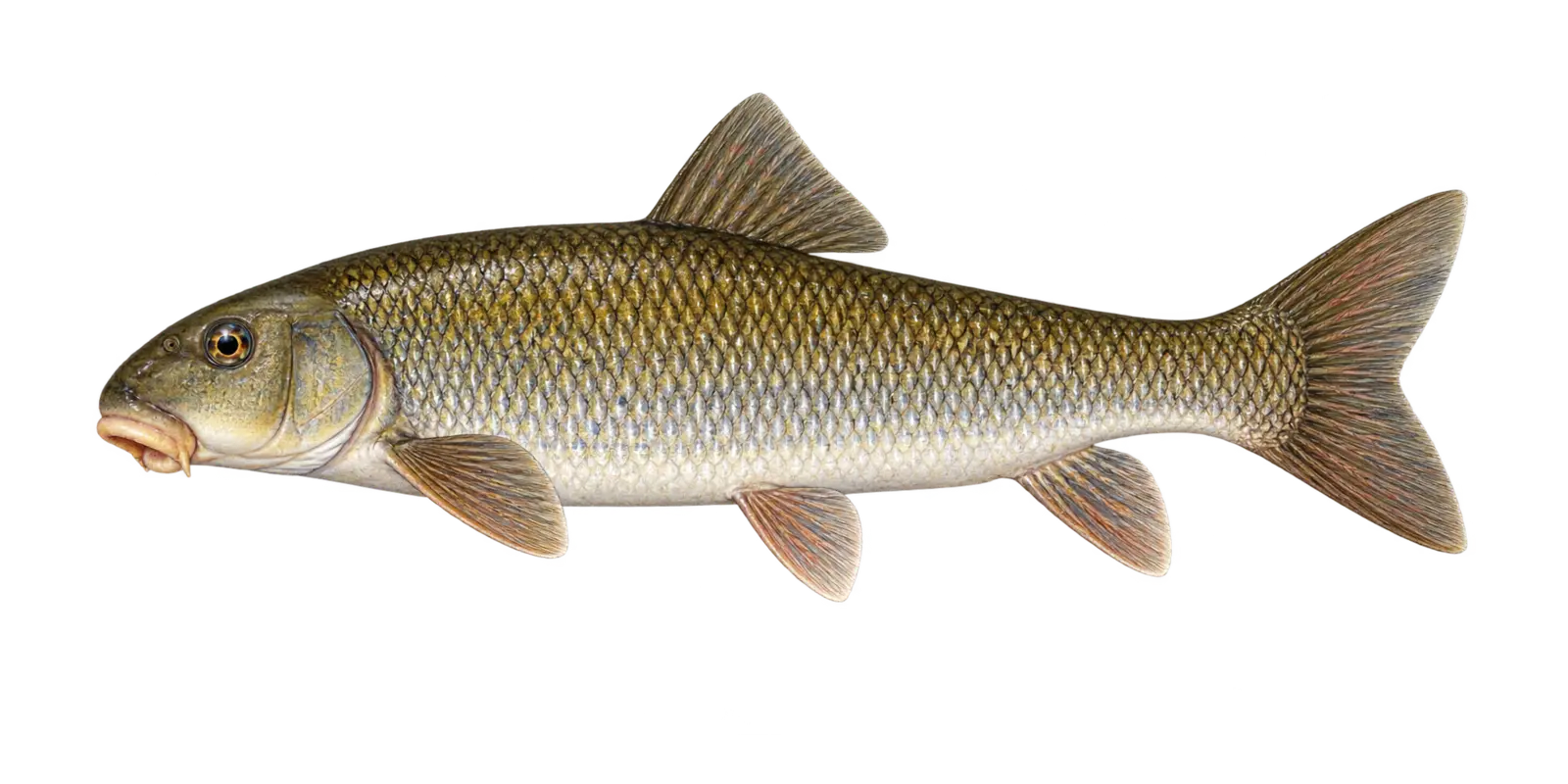 Downturned sucker mouth
Native bottom feeder
White Sucker
Catostomus commersonii
- Spring movement
- Year-round habitat
White suckers feed along the bottom on insects, small organisms, and organic material. In addition, they are a normal native part of the lake’s food web and can become prey for large predators.
How to recognize it
In particular, look for a blunt snout, a fleshy mouth set underneath the head, large obvious scales, and a long silver-bronze body without barbels.
Ball Club survey snapshot
White sucker were documented in the 2022 survey. However, one 22-inch fish was measured in 2024, which is too small a sample to describe the lake’s full size range.
Where it tends to be
This bottom-oriented fish can use shallow water, slopes, and deeper areas. For example, spring movements may bring fish toward tributaries or shoreline zones.
Often confused with
By contrast, redhorse species often have red-orange fins and different lip shapes. Carp have barbels at the mouth; white suckers do not.
Starting depth zone
Bottom habitat across a broad depth rangeThe lake bottom is the key relationship.
Plain-English fish glossary
- Breakline
- A place where the bottom changes depth more quickly.
- Forage fish
- A fish that is an important food source for larger predators.
- Littoral zone
- Shallower water where enough light reaches the bottom for plants to grow.
- Adipose fin
- A small fleshy fin between the main dorsal fin and tail on fish such as cisco.
- Trap net
- A passive DNR sampling net often used near shore. Its catch is not a direct count of every fish in the lake.
- Gill net
- A DNR survey net used to sample open-water fish. Results describe that sampling effort, not a current bite report.
Illustration field marks use state and federal fisheries references. Ball Club measurements and habitat notes use Minnesota DNR LakeFinder survey records. Survey catches are snapshots and do not guarantee current abundance or fishing success.
JavaScript is needed to switch fish cards. The Minnesota DNR fish guide remains available at dnr.state.mn.us/fish.
DNR survey context
What the Recent Surveys Tell Us
- 2025: Targeted work documented cold, oxygenated cisco habitat. It was a habitat snapshot, not a fishing forecast.
- 2024: Nearshore and trap-net work documented 21 nearshore species. The fish-community health score exceeded the DNR threshold for exceptional use.
- 2022: Standard survey work found northern pike most common in gill nets, measured a broad size range of walleye, and found abundant cisco in a special deep-water sample.
Seasonal starting points
Ball Club Lake Fishing Guide by Season
Seasonal guidance provides a starting framework, not a promise about a particular day. Water temperature, wind, forage movement, and recent weather should decide the final location and presentation.
Spring
After ice-out, warming shoreline areas and the first developing vegetation can concentrate activity. Pike often remain connected to shallower habitat, while walleye may use shoreline breaks, points, and other routes between spawning areas and early-season feeding water. Cold water favors controlled speed and careful coverage.
Summer
Clear water and stronger sunlight can shift the best windows toward wind, low light, deeper edges, and offshore structure. Weedlines may still matter, but the nearby drop and access to deeper water can be equally important. Watch the depth finder, manage boat angle, and avoid assuming every fish is shallow.
Fall
Cooling water can bring renewed predator activity and create opportunities along remaining green vegetation, structural transitions, and routes connected to deeper water. Fall weather can change quickly. A flexible plan that includes several depth ranges is more useful than committing to one pattern before launching.
Winter
Ball Club offers ice-fishing possibilities for walleye, pike, perch, and panfish, but lake ice is never automatically safe. Conditions vary by location and date. Verify access, check ice continuously, carry proper safety equipment, and use local information before traveling onto the lake.
Plan before you launch
Ball Club Lake Fishing Guide: Map, Access, and Official Resources
Select the straightened contour map to open a large viewer, then confirm current access, regulations, and licensing through the official resources.
Before you fish
Ball Club Lake Fishing Guide: Trip Planning Notes
Use these reference points with current Minnesota DNR information when preparing for a day on Ball Club Lake.
Lake Size and Shoreline
The current Minnesota DNR LakeFinder record lists 4,335.27 acres and 19.47 miles of shoreline. Some older maps and web pages display different acreage figures.
Depth and Habitat
With a maximum depth of 85 feet, Ball Club combines deep basin water with 984 acres of littoral habitat. As a result, anglers can work through a wide range of shallow, mid-depth, and deep structural zones.
Documented Fish Community
Minnesota DNR records list northern pike, walleye, largemouth bass, black crappie, bluegill, yellow perch, pumpkinseed, rock bass, bowfin, white sucker, and tullibee or cisco.
Launch Planning
For launch planning, the DNR access record lists public options, including a south-end access. It also describes limitations at some west-side sites. Therefore, check the current access record before choosing a launch.
Aquatic Invasive Species
Zebra mussel is listed in the DNR record. Follow all aquatic invasive species rules, drain water, remove visible material, and dispose of bait properly before leaving the access.
Wind and Light
Ball Club’s clear water can make wind direction, cloud cover, and time of day especially important. Wind-driven structure and lower-light periods can create stronger feeding windows, while bright conditions may call for deeper water, longer casts, or more precise boat position.
Contour Map Use
The map is a planning reference that helps anglers understand lake shape and depth changes. It is not a navigation chart and should not replace current electronics, safe boating practices, local hazard awareness, or on-the-water judgment.
Winter Safety
The lake supports winter fishing, but no website can verify ice safety for every location. Check conditions locally, test ice as you travel, carry appropriate safety equipment, and never rely on the calendar alone.
Ball Club Lake catches
Ball Club Lake Fishing Guide: See the Fishery and Plan Your Day
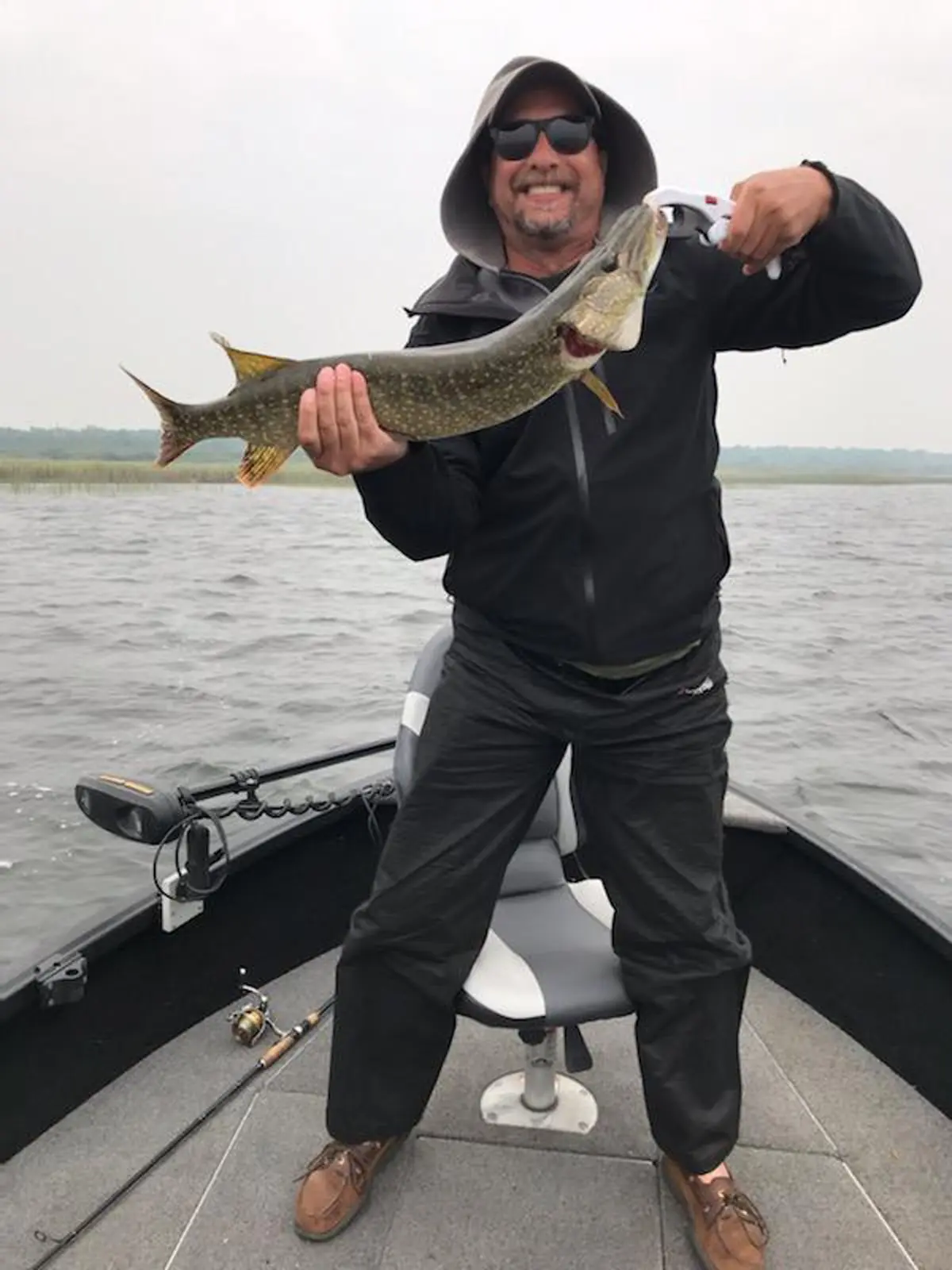
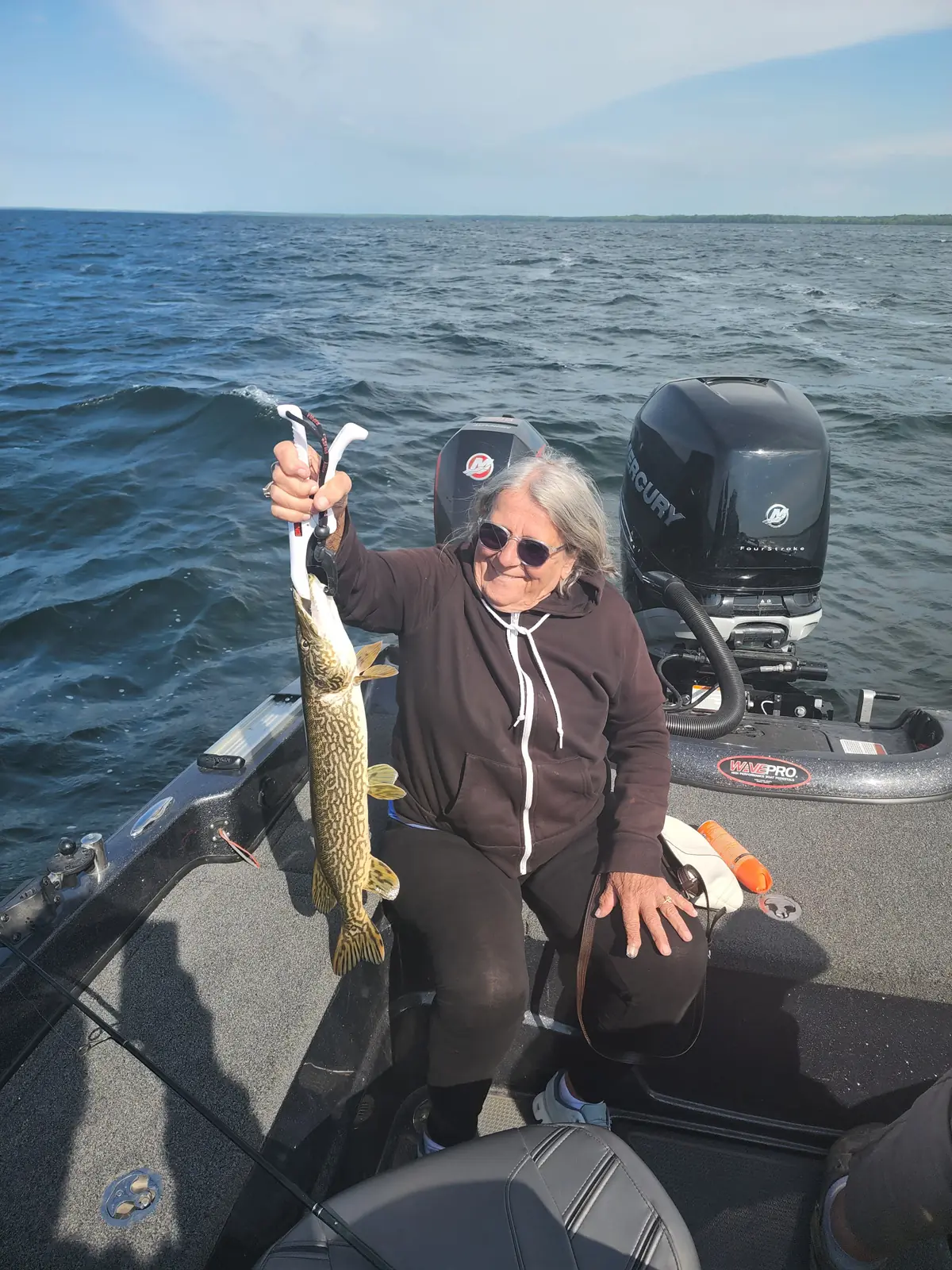
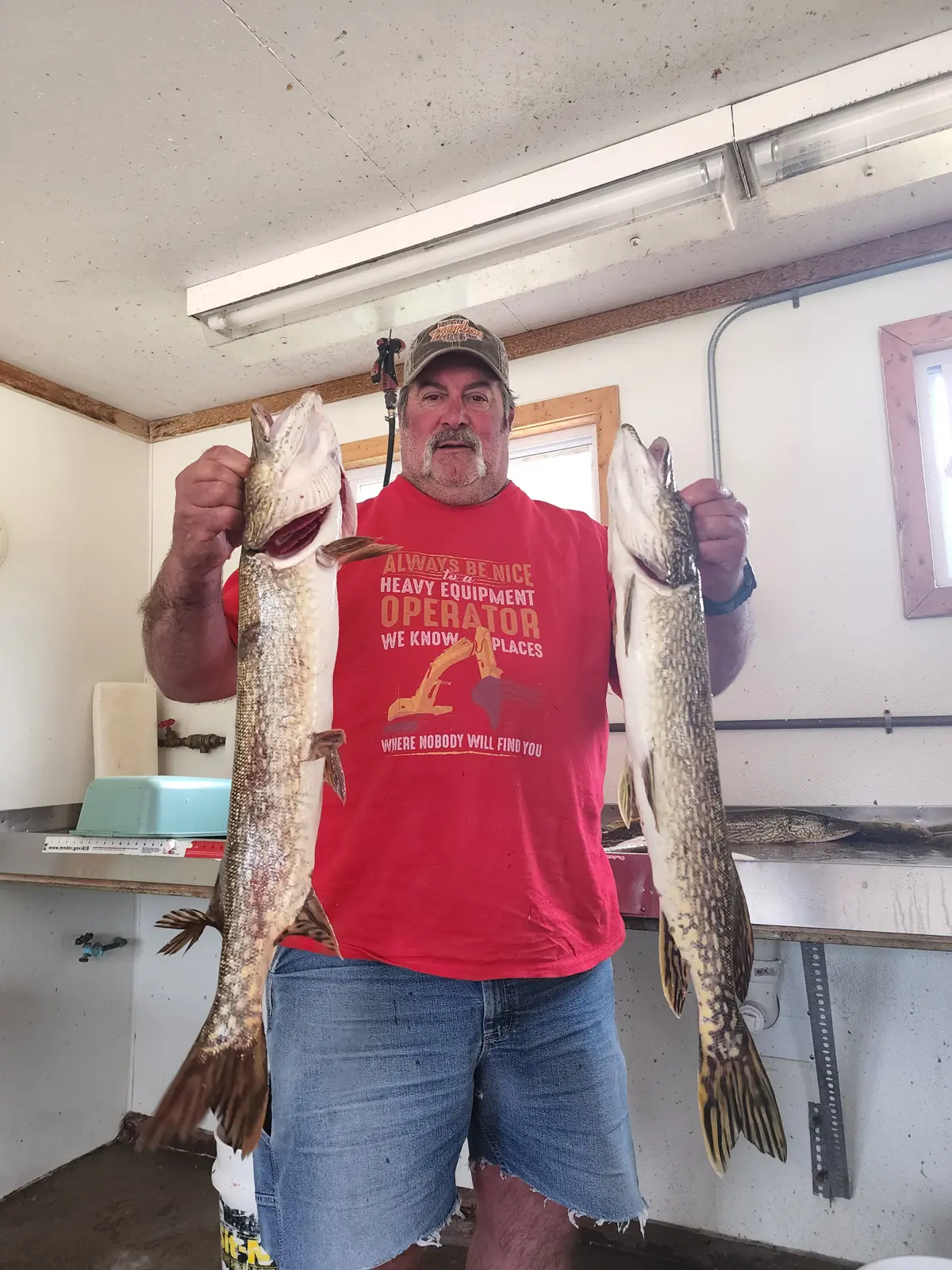
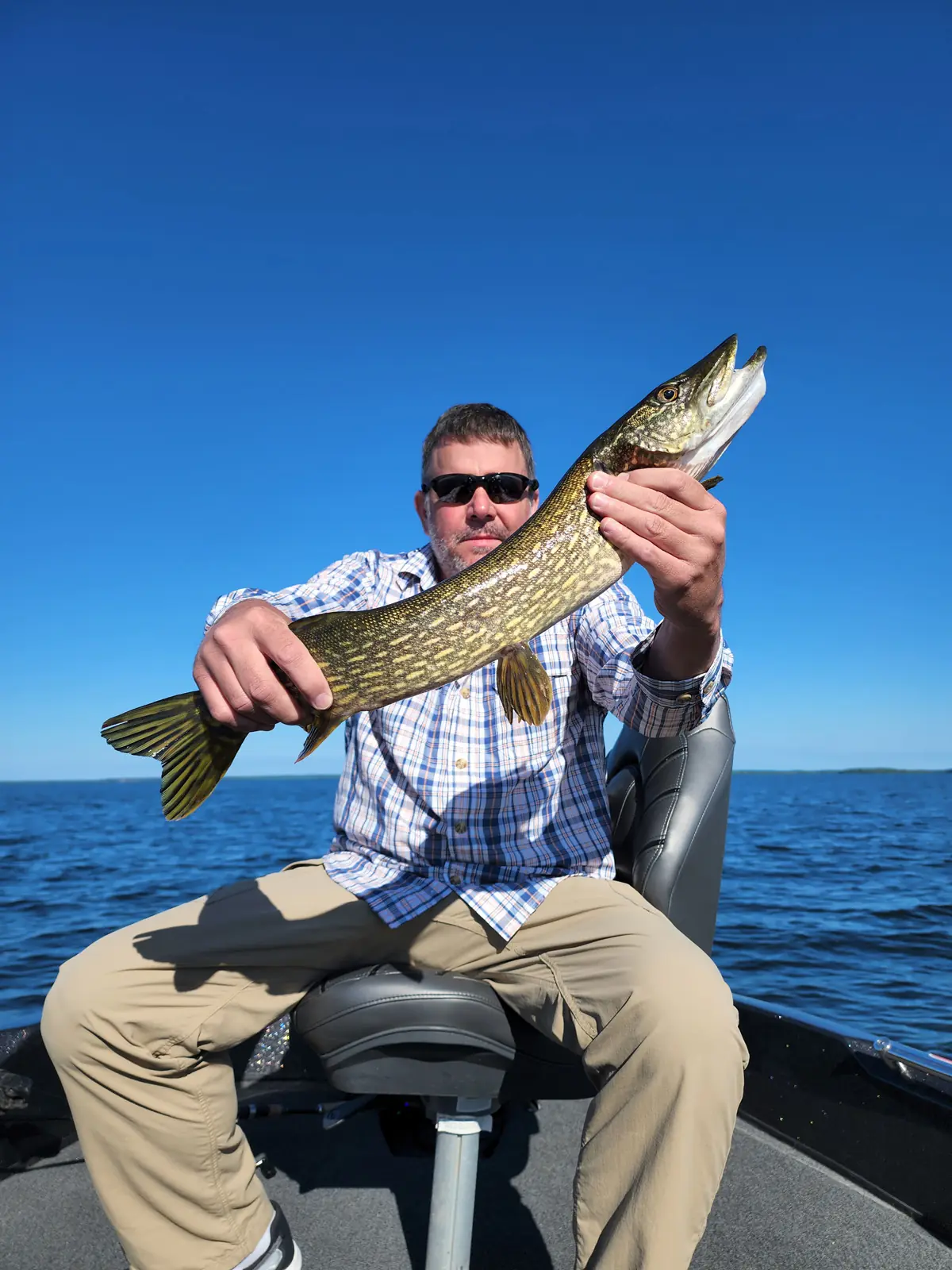
These northern pike were caught on Ball Club Lake. Select any image for a closer look.